About Me

My photo
EDUCATION: Holt High School, Holt Mich., Lansing Community College, Southwestern Theological Seminary, National Apostolic Bible College. MINISTERIAL EXPERIENCE:61 years of pastoral experience, 11 churches in Arizona, New Mexico and Florida. Missionary work in Costa Rica. Bishop of the Districts of New Mexico and Florida for the Apostolic Assembly. Taught at the Apostolic Bible College of Florida and the Apostolic Bible College of Arizona. Served as President of the Florida Apostolic Bible College. Served as Secretary of Education in Arizona and New Mexico.EDUCACIÓN:Holt High School, Holt Michigan, Lansing Community College, Seminario Teológico Southwestern, Colegio Bíblico Nacional. EXPERIENCIA MINISTERIAL:51 años de experiencia pastoral, 11 iglesias en los estados de Arizona, Nuevo México y la Florida. Trabajo misionera en Costa Rica. Obispo de la Asamblea Apostólica en los distritos de Nuevo México y La Florida. He enseñado en el Colegio Bíblico Apostólico de la Florida y el Colegio Bíblico Apostólico de Arizona. Presidente del Colegio Bíblico de la Florida. Secretario de Educación en los distritos de Nuevo México y Arizona.

Sunday, May 4, 2014

WHY DON'T CHRISTIANS OBSERVE THE SABBATH?

Genesis 2:1-3; Matthew 12:6-8

In order for the keeping of the Sabbath Day to be binding on New Testament Christians, it would have to be a commandment which preceded and survived the Law of Moses. If it originated with the Law of Moses, it would be unique to that dispensation and would be binding only upon that dispensation, unless a clear New Testament statement made it also binding upon the church.
That the command to keep the Sabbath Day was for Israel only will be seen by the following. The first mention of the Sabbath in the Bible is Exodus 16:23: “And he said unto them, This is that which the Lord hath said, Tomorrow is the rest of the holy Sabbath unto the Lord: bake that which ye will bake today, and seeth that ye will seethe; and that which remaineth over lay up for you to be kept until the morning.”
There is no biblical record before this time of anyone keeping the Sabbath or even being aware of it. The word "remember" in Exodus 20:8 ("Remember the Sabbath day, to keep it holy") refers back to the command in Exodus 16:23, not to something Israel had previously known, for there is not one Scripture which suggests Israel was aware of the Sabbath before leaving Egypt. No one before Israel knew of the Sabbath: “The Lord made not this covenant with our fathers, but with us, even us, who are all of us here alive this day” (Deuteronomy 5:3).”
The elements of the covenant God made with Israel, including the requirements to keep the Sabbath, had not been given to any previous generation. The covenant in all its aspects originated at Sinai. Not even Israel had heard of it before this time: “Thou camest down also upon mount Sinai, and spakest with them from heaven, and gavest them right judgments, and true laws, good statutes and commandments: And madest known unto them thy holy sabbath, and commandedst them precepts, statutes, and laws, by the hand of Moses thy servant” (Nehemiah 9:13-14).
The Law of Moses was a covenant consisting of 613 commandments that God made exclusively with the nation of Israel. These commandments must not be viewed as independent from each other, all of them together formed one covenant. To break one of them was to break the entire covenant; to be responsible for one of them was to be responsible for all of them (James 2:10; Galatians 5:1-40

THE SABBATH WAS A SIGN (Ezekiel 20:12)
The Sabbath days were given to Israel by God to be a sign between Him and Israel alone: "Moreover also I gave them my sabbaths, to be a sign between me and them, that they might know that I am the Lord that sanctify them." They were never a part of a covenant between God and any other people. “He sheweth his word unto Jacob, his statutes and his judgments unto Israel. He hath not dealt so with any nation: an as for his judgments, they have not known them. Praise ye the Lord” (Psalm 147:19-20).
The statutes and judgments of the law given to Israel were unique to them; God did not deal in that way with any other nation. Those things were unique to the Law of Moses, therefore, were not binding on other peoples at other places and times.
The Sabbath was a sign between God and Israel only (Exodus 31:12-17). The only way the Sabbath could be a sign between God and Israel would be if it were unique to that relationship, i.e. if God required all men to keep the Sabbath, what kind of a special sign would it have been between Him and Israel? Something is a sign only because it is unique, special. If it is common, it is no sign. The Sabbath was a visible sign which would allow God immediately to test Israel's obedience to Him. (Exodus 16:4-5).

A NEW COVENANT
God predicted He would make a new covenant with Israel (Jeremiah 31:31-34). The new covenant God will yet make with Israel will be unlike the covenant He made with them at Sinai. It will not be according to that covenant. The feature of this covenant is a knowledge of God superior to that offered by the Law of Moses. Instead of having to do with days, festivals, offerings, and so forth, this new covenant will feature a deeply personal relationship with God, indicated by having His law written in their hearts. Nothing is said at all about the Sabbath.

GOD’S SEVENTH DAY OF REST
The reference to God's rest on the seventh day in Genesis 2:1-3 indicates that God blessed that specific  day only. A careful examination of this passage will reveal nothing about God blessing every seventh day. He blessed that specific seventh day, the day following the creation of man. This seventh day is not called the Sabbath, nor is it ever referred to as the Sabbath. It was simply the seventh day, and God sanctified that day, or set it apart, for His rest.
That God does not rest every seventh day or on the Jewish Sabbath is seen in John 5:17. Jesus had just healed a man on the Sabbath, for which He was condemned by the Jews. Jesus said, "My Father worketh hitherto, and I work." The clear implication was that the Father was working on the Sabbath and so was Jesus. This is confirmed in John 5:19: "Then answered Jesus and said unto them, Verily, verily, I say unto you, The Son can do nothing of himself, but what he seeth the Father do: for what things so ever he doeth, these doeth the Son likewise." Since Jesus healed the man on the Sabbath, it was clear the Father was at work also.
While it has been widely assumed that God created the Sabbath day on the seventh day of creation, and that faithful men observed the Sabbath every seventh day from that day forward, there is not one word about this in any Scripture. Never, prior to the exodus from Egypt, is any faithful man seen keeping the Sabbath or even being aware of it. Since God himself was not resting on the Sabbath in the New Testament, the day was clearly to be observed by the Israelites only.

JESUS CAME TO FULFILL PROPHECIES
Jesus Christ did not come to obey the law; He came to fulfill the prophecies contained in the law and the prophets (Matthew 5:17-18). It is commonly reported by modern law keepers that these verses prove Jesus Himself came to obey the law. The word "fulfill" is said to mean "obey." Actually, the Greek word pleroo, translated "fulfill," means to finish, to end, to make complete, to cause to expire.
The key to interpreting the verses is contained within the verses themselves. Jesus said, "Think not that I am come to destroy the law, or the prophets .... " He came to fulfill both the law and the prophets. Whatever He meant by fulfilling the prophets, He meant the same about fulfilling the law. How could he obey the prophets?
The basic ministry of the prophets was predictive, to tell of coming personages and events, and especially the Messiah. Both the law and the prophets were heavily weighted with elements predictive of the coming Messiah. These Jesus fulfilled (Luke 24:27,44).
The word "law" has a broad use in the Old Testament. It may refer to:
1. The ten commandments (Exodus 20:1-17; 24:12).
2. A regulation within the Law of Moses (Leviticus 7:7).
3. The Book of Deuteronomy (Deuteronomy 1:1-5; 27:1-8; Joshua 8:30-35).
4. The entire Pentateuch (Luke 24:44; I Corinthians 14:34 with Genesis 3:16; I Chronicles 16:40).
5. One of the two major sections comprising the entire Hebrew Scriptures (Matthew 5:17).
6. The entire Hebrew Scriptures (Matt. 5:18; Rom. 3:10-19; Isa. 28:11 with I Cor. 14:21; Jn. 5:10 with Jeremiah 17:21).
The use of the word "law" alone in Matthew 5:18 must be understood in light of the context, as must all mentions of the word. The previous verse has already indicated that the subject of Jesus' statement is both the law and the prophets. The second use of the word "law" alone is an abbreviated way to refer to the entire Old Testament.
Jesus fulfilled the Law of Moses not by obedience to it but by His role as the object of all the predictive elements of the law. This included the meat offerings, the drink offerings, the holy days, the new moons, the Sabbath days, the Passover, the priesthood, and so forth. (Colossians 2:16-17; I Corinthians 5:7; and Hebrews 10:1-20.)

JESUS BROKE THE SABBATH
Those who believe keeping the Law of Moses is essential to New Testament salvation hotly dispute this claim. But it is the clear teaching of the New Testament. As Jesus visited the pool of Bethesda on the Sabbath, He healed an impotent man, commanding him, "Rise, take up thy bed, and walk" (John 5:8). The man obeyed, totally healed. This action of Jesus on the Sabbath was bitterly condemned by the Jews. In fact, they sought to kill Him, "because he not only had broken the Sabbath, but said also that God was his Father, making himself equal with God" (John 5:18).
Some suggest that the Jews merely supposed Jesus had broken the Sabbath, that the only thing He broke was a commandment or tradition of men. But Jeremiah 17:19-22 records the commandment of Jehovah. The statement of John is clear: "...he...had broken the Sabbath...." He did not say, "The Jews supposed He had broken the Sabbath."
On another occasion when the Pharisees accused Jesus and His disciples because they plucked ears of corn to eat as they walked through a field on the Sabbath, Jesus' answer included this statement, "Or have ye not read in the law, how that on the Sabbath days the priests in the temple profane the Sabbath, and are blameless?" (Matthew 12:5). (See Numbers 28:9-10; 18-19.) Jesus did not suggest that the priests were exempt from the Sabbath obligations and that therefore their strenuous labor on that day was not a violation of the commandment. Instead, He said, "...the priests...profane the Sabbath...." And yet, He said, they "... are blameless." In other words, even to the nation of Israel under the dispensation of the Law of Moses, there were times and circumstances when the law was not binding!
In His defense of His disciples' plucking the corn on the Sabbath, Jesus also referred the Pharisees to David's clear violation of the law, a violation for which he received no condemnation: "Have ye not read what David did, when he was an hungered, and they that were with him; How he entered into the house of God, and did eat the shewbread, which was not lawful for him to eat, neither for them which were with him, but only for the priests?" (Matthew 12:3-4). The shewbread belonged only to Aaron and his sons. It was to be eaten only in the holy place by them. It was most holy unto the Aaronic priesthood. (Leviticus 24:9.) Clearly it was unlawful for David, who was of the tribe of Judah, not Levi, to eat this holy bread. Jesus said it was unlawful. Yet there was no guilt attached to the action. Jesus explained His refusal to condemn the disciples this way:“But I say unto you, That in this place is one greater than the temple. But if ye had known what this meaneth, I will have mercy, and not sacrifice, ye would not have condemned the guiltless. For the Son of man is Lord even of the Sabbath day” (Matthew 12:6-8).
The one greater than the temple is, of course, Jesus Himself. The simple implication of this is that anything done under the Lordship of Jesus Christ and which does not receive condemnation from Him cannot be sinful. Even under the Law of Moses, the supreme desire of God was not the hair-splitting observance of legal technicalities, but the showing of mercy. (See Hosea 6:6.) Jesus Christ was Lord even of the Sabbath. In other words, Jesus Himself is greater than any of His commandments. While there is not one account anywhere in Scripture of the Lord failing to deal with a violation of moral law, there are indeed accounts of His refraining from passing judgment on violations of ceremonial law. The Sabbath and all aspects of the tabernacle were ceremonial; that is, they were in some way predictive of the coming Messiah.

GOD WARNED OF VAIN SABBATH KEEPING (Isaiah 1:10-17)
In this passage, the disobedient Israelites are referred to spiritually as Sodom and Gomorrah. (Revelation 11:8.) They went through the motions of the ceremonial law, but it was repulsive to God. The ceremonial aspects of the Law of Moses were never meant by God to be an end in themselves. The law was a schoolmaster to bring Israel to Christ (Galatians 3:24). Those who kept the ceremonial aspects of the law without a heart in right relationship with God were not accepted by Him. On the other hand, Gentiles who may have had a heart right with God could have been accepted by Him, even without the works of the law. (Romans 2:25-29.)
God caused the Sabbaths to cease (Hosea 2:11). The reason for this action was clearly the spiritual adultery of Israel. But had the Sabbath been an end in itself—if the point of the Sabbath was the keeping of the Sabbath—it would seem strange that the same God who commanded it would now stop it.
God caused the Sabbaths to be forgotten (Lamentations 2:6). Again, if the Sabbath was an end in itself, it would seem very strange for the Lord, who commanded the observance of the day, to cause it to now be forgotten. It would seem rather that He would wish to cause it to be remembered. Early Judaizers wanted the Christians to keep the Law of Moses, but the church would not command such a thing (Acts 15:5,24).
A careful reading of Galatians 3, 4, 5 will serve to put the Law of Moses in its proper perspective. It was for the nation of Israel only; it began at Mount Sinai and had no impact whatsoever on any previous covenant God had made with people; it ended with the coming of Christ. The danger of going back under the law is clear (Galatians 4:10-11). Christ fulfilled the Sabbath (Colossians 2:16-17).
The Sabbath, a day of rest, was predictive of the coming Messiah and the spiritual rest believers would find in Him. The Sabbath was merely a shadow; it was no substance in and of itself. (See also Hebrews 10:1.) Now that the substance has come in the person of Jesus Christ, there is no longer any need for the shadow. Indeed, it would be an insult to Jesus and spiritually dangerous to maintain a fascination with any ceremonial law whose purpose has been served. It would be just as distasteful to God for New Testament Christians to observe the Sabbath as it would be for them to offer the blood of bulls and goats.

AN EXEGESIS OF EXODUS 20:11
This verse is used by law keepers to teach that the Sabbath was created on the seventh day, just after the creation of man. Further, it is taught from this that all faithful men, from Adam on, were obliged to keep the Sabbath. A careful study of the verse will prove otherwise.
The words "seventh" and "Sabbath" are not synonymous. The Hebrew word for "seventh" is shebeee. The word for "Sabbath" is shabbath. The word literally means "intermission." Never in Scripture is shebeee translated "Sabbath," and never is shabbath translated "seventh." They are totally different words. We know of the seventh day from creation, but not the Sabbath. God is not said to have rested on the Sabbath; He is said to have rested on the seventh day. The word "Sabbath" never appears in Scripture until Exodus 16:23.
While the Hebrew word translated "rested" is from the same root as the word transliterated "sabbath," this does not indicate that the seventh day was formally instituted as the Sabbath in Genesis 2. The word simply means "rest" and is used in the Old Testament of rests occurring on other than the Sabbath Day.
The key word is "wherefore". The word "wherefore" is translated from two Hebrew words which seem to carry the meaning "for this reason." In other words, God's rest on the seventh day was the pattern for Israel's rest on the Sabbath day.
The Sabbath is in the seventh “Six days may work be done; but in the seventh is the Sabbath of rest....” (Exodus 31:15). In the beginning it was the seventh day; under the law it became the Sabbath day. The seventh day became the Sabbath for Israel only. There is no absolute guarantee that the Sabbath was on the same day as the original seventh. Time for Israel began in Exodus 12:1-2. Exodus 20:11 say God blessed the seventh in the beginning, not the Sabbath (Genesis 2:1-3). God blessed the Sabbath in giving the manna. (Exodus 16.)
The practice of worshipping on the seventh day did not arise until the exile, when the Jewish people began to build synagogues and to gather on the Sabbath to read the Scriptures and to pray. The Law of Moses itself contained no commandment to worship on the Sabbath. Instead, it prohibited any kind of work and most kinds of activity on the Sabbath. The Hebrew word translated “”Sabbath” (shabbath) essentially means “to cease.” The commandment was that on the Sabbath all labor was to stop.

THE HEBREW SABBATH AND THE MODERN SATURDAY
It is widely assumed that the modern Saturday is the Hebrew Sabbath which has been observed by orthodox Jews since the exodus from Egypt. All of the discussions about special days are complicated by the fact that there are approximately 40 calendars in use in the world today, and by problems initiated with world travel like the International Date Line.
The calendar of Israel at Sinai was a solar calendar, and it is not to be confused with the modern Jewish solar-lunar calendar of A.D. 359. The Hebrew calendar began its dating from the deliverance from Egypt. The Hebrews retained the Egyptian calendar of 12 months of 30 days, but, instead of adding the five supplementary days at the end of the year, they added three at the end of the sixth month, and two at the end of the twelfth month. The 15th day of Abib, the first month, had to be a Sabbath every year, which meant that the first and eighth of Abib were fixed Sabbaths, as were the seven Sabbaths following the 15th of Abib (Lev. 23:6,7,11,15-16). The 50th day would then be Pentecost:
There is nothing in the Bible to determine the length of a Sabbath. The Scriptures use the same word to describe:
1. A rest one day long (Ex. 20:8-11; Deut. 5:12-15.
2. A rest two days long (Lev. 23:15,16,21).
3. A rest one year long (Lev. 25:4-8).
4. A rest two years long (Lev. 25:8-12).
5. A rest seventy years long (II Chron. 36:21).

Since the Sabbath is not mentioned prior to Israel's exodus from Egypt, since it was given to the nation of Israel only and no one else, since it was a shadow of the coming Messiah, and since the New Testament never enjoins its observance upon the church but rather rejects the Law of Moses as binding upon Christians, we conclude that the Sabbath belonged to the dispensation of the law only. It would be a serious error to bring this dispensational distinctive into the dispensation of grace.

Sunday, April 27, 2014

¿LO PUEDO HACER?

“Fíate de Jehová de todo tu corazón, Y no te apoyes en tu propia prudencia. Reconócelo en todos tus caminos, Y él enderezará tus veredas.” Proverbios 3:5-6

Algunas preguntas a menudo hechas por creyentes en la Iglesia son: “¿es correcto ir a bailes o a las películas, escuchar música mundana, fumar, beber, o participar en otros placeres mundanos y  diversiones?”

Sé que muchísimos creyentes están preocupados por cuestiones similares. Usted encontrará que ciertas prácticas son claramente condenadas en la Biblia. A medida que escudriñe las Escrituras, usted encontrará que hay muchas otras prácticas, comunes en el mundo de hoy, que no se mencionan. Usted podría preguntarse, ¿qué debo hacer ahora?

Nos gustaría darle una serie de normas que le ayudará a decidir si debe o no participar en una actividad cuestionable.

1. En primer lugar, ¿está claramente prohibido por Dios para los creyentes? Si esto es así, evítelo, no participe de ello. Si usted no sabe, no lo hagas hasta que hayan tenido la oportunidad de averiguarlo (1 Tesalonicenses 5:22).

2. ¿Hay alguna gloria para Dios en ello? En I Corintios 10:31, leemos esta declaración clara: “Si, pues…hacéis otra cosa, hacedlo todo para la gloria de Dios.” Antes de participar en la actividad en cuestión, puede francamente usted pedir la bendición de Dios sobre ello, ¿creyendo que Él se honrará por su participación?

3. Pregúntese, “¿es del mundo?” Si es, entonces no es “de Dios.” Él dijo acerca de Sus discípulos, “No son del mundo, como tampoco yo soy del mundo.” (Juan 17:16). Él no era “del mundo”. Él estaba en el mundo, pero no era del mundo (I Juan 2:15-17).

4. ¿Lo habría hecho Jesús? Él nos ha dejado un ejemplo que deberíamos seguir Sus pasos (I Pedro 2:21).

5. ¿Quisiera ser encontrado haciéndolo cuándo Jesús vuelve? Alguien ha comentado sabiamente, “¡No haga nada, diga algo, o vaya a cualquier lugar que le causaría vergüenza si Jesús viniera!”(I Pedro 2:28)

6. ¿Puede sentirse libre para hacerlo cuándo usted recuerda que Jesús mora dentro de usted? “O ignoráis que vuestro cuerpo es templo del Espíritu Santo, el cual está en vosotros, el cual tenéis de Dios, y que no sois vuestros” (1 Corintios 6:19; Efesios 4:30)

7. ¿Es una conducta apropiada para un hijo de Dios? Cuando el hijo de un rey actúa en una manera indigna, él trae la desgracia al nombre de su padre. Lo mismo sucede con el cristiano que se comporta de una manera impropia (Romanos 2:24, Colosenses 1:10).

8. ¿Qué efecto tendrá su conducta en otros? ¿Será esto un testimonio bueno a los inconversos, o decidirán ellos que no hay realmente ninguna diferencia entre un cristiano y un inconverso (II Corintios 5:17)? ¿Causará esto a alguien que es joven en la fe a tropezar? El apóstol Paul advirtió que ningún hombre debería poner “tropiezo u ocasión de caer al hermano” (Romanos 14:13).

9. ¿Existe la más mínima duda en su mente al respecto? Si es así, entonces no lo hagas, porque “él que duda es condenado,” porque  “todo lo que no proviene de fe, es pecado” (Romanos 14:23).

En relación a esto, debe recordar bien que “no estamos bajo la ley, pero bajo la gracia” (Romanos 6:14-15).Esto no significa que podamos hacer como nos gusta, sino que más bien significa que queremos hacer lo que a Dios le gusta porque él ha hecho tanto por nosotros. No evitamos placeres mundanos y divisiones porque tenemos que hacerlo, pero porque queremos.

La razón por la cual queremos es porque Cristo murió por nosotros, y ahora nuestras ambiciones son vivir en una manera que lo complacerá “Nosotros le amamos a él, porque él nos amo primero” (I Juan 4:19, II Corintios 5:14-15). Dios no dice, "Si se mantiene lejos de placeres pecaminosos, usted será un cristiano". Pero él dice, en efecto, al creyente, "¡Tú eres un cristiano! Ahora vive de una manera que sea consistente con su alta vocación” (Efesios 4:1).

Es posible que un cristiano pueda olvidar su posición digna, y ocuparse de las cosas del mundo. En tal caso, Dios lo devolverá por corrección amorosa, así como un pastor devuelve a una oveja errante colocando su cayado alrededor de su cuello. Así, si la gracia de Dios es olvidada por el creyente, él será restaurado por la mano castigadora de Dios.

IS IT RIGHT?

"Trust in the Lord with all your heart, And lean not on your own understanding; In all your ways acknowledge Him, And He shall direct your paths.” Proverbs 3:5-6

Some of the questions often asked by believers in the Church are: “Is it right for a believer to go to dances or to the movies, to listen to worldly music, to smoke, to drink, or to participate in other worldly pleasures and amusements?

I know that a great many believers are troubled by similar questions. You will find that certain practices are clearly condemned in the Bible. As you search the scriptures, you will find that there are many other practices, common in the world today, which are not mentioned. You might ask; what do I do now?

We would like to give you a series of standards which will help you to decide whether or not to engage in a questionable activity.

1.  First of all, is it distinctly forbidden by God for believers? If it is, avoid it, do not partake of it. If you do not know, don’t do it until you have had a chance to find out (I Thessalonians 5:22).

2.  Is there any glory for God in it? In I Corinthians 10:31, we read this plain statement: “Whatsoever ye do, do all to the glory of God.” Before you engage in the activity in question, can you honestly ask for God’s blessing upon it, believing that He will be honored through your participation?

3.  Ask yourself, is it “of the world?” If it is, then it is not “of God.” He said concerning His disciples, “They are not of the world, even as I am not of the world” (John 17:16). He was not “of the world” at all. He was in it, but no of it (I John 2:15-17).

4.  Would Jesus have done it? He has left us an example that we should follow His steps (I Peter 2:21).

5.  Would you like to be found doing it when Jesus returns? Someone has wisely remarked, “Don’t do anything, say anything, or go anywhere that would cause you shame if Jesus should come! (I John 2:28).

6.  Can you feel free to do it when you remember that Jesus dwells within you? “Know ye not that your body is the temple of the Holy Ghost which is in you, which ye have of God, and ye are not your own?” (I Corinthians 6:19; Ephesians 4:30)

7.  Is it fitting conduct for a child of God? When a king’s son acts in an unworthy manner, he brings disgrace on his father’s name. So does the Christian who behaves in an unbecoming way (Romans 2:24; Colossians 1:10).

8.  What effect will your conduct have on others? Will it be a good testimony to the unsaved, or will they decide that there is really no difference between a Christian and an unbeliever (II Corinthians 5:17)? Will it cause someone who is young in the faith to stumble? The apostle Paul warned that no man should put “a stumbling block or an occasion to fall in his brother’s way” (Romans 14:13).

9.  Is there the least bit of doubt in your mind about it? If so, then don’t do it, for “he that doubteth is damned,” for “whatsoever is not of faith is sin” (Romans 14:23).

In connection with this, it is well to remember that we “are not under the law, but under grace” (Romans 6:14-15). This does not mean that we may do as we like, but rather it means we want to do what God likes because He has done so much for us. We do not avoid worldly pleasures and amusements because we have to, but because we want to.

The reason we want to is because Christ died for us, and now our ambitions are to live in a manner that will please Him. “We love Him, because He first loved us” (John 4:19; II Corinthians 5:14-15). God does not say, “If you keep away from sinful pleasures, you will be a Christian.” But He does say, in effect, to the believer, “You are a Christian! Now live in a way that is consistent with your high calling” (Ephesians 4:1).

It is possible that a Christian may forget his dignified position, and go in for the things of the world. In such a case, God will bring him back by loving correction, just as a shepherd brings back a wandering sheep by placing his crook around its neck. Thus, if God’s grace is forgotten by the believer, he will be restored by God’s chastening hand. 

Friday, April 18, 2014

NO ESTA AQUI, HA RESUCITADO


“Pasado el día de reposo, al amanecer del primer día de la semana, vinieron María Magdalena y la otra María, a ver el sepulcro. Y hubo un gran terremoto; porque un ángel del Señor, descendiendo del cielo y llegando, removió la piedra, y se sentó sobre ella. Su aspecto era como un relámpago, y su vestido blanco como la nieve. Y de miedo de él los guardas temblaron y se quedaron como muertos. Mas el ángel, respondiendo, dijo a las mujeres: No temáis vosotras; porque yo sé que buscáis a Jesús, el que fue crucificado. No está aquí, pues ha resucitado, como dijo. Venid, ved el lugar donde fue puesto el Señor.” Mateo 28:1-6

¡Él no está aquí, ha resucitado! Estas siete palabras declaran la verdad más importante en la Biblia entera. ¿Usted puede preguntar, “Podía alguna verdad ser más importante que la verdad del nacimiento virginal de Cristo o, la verdad de la cruz de Calvario? ¿O los milagros que Cristo hizo, sanar los enfermos, dar la vista a los ciegos, y resucitando los muertos?” ¡Sí! ¡Porque, no importa lo que hizo Jesús, o quién era, si la muerte lo podría haber mantenido en la tumba, todo lo demás hubiera sido en vano! Pero si se predica de Cristo que resucitó de los muertos, ¿cómo dicen algunos entre vosotros que no hay resurrección de muertos?

La cruz y la resurrección de Jesús son inseparables, el uno demanda el otro. Si Jesús no hubiera muerto no habría por supuesto ninguna resurrección, de ahí ninguna fe, ninguna salvación, ninguna nueva creación; pero se no hubiera conquistado la muerte, el infierno, y la tumba Su muerte hubiera sido en vano. ¡Por lo tanto aquellos  que niegan Su resurrección más vale que nieguen que fue crucificado! “Porque si no hay resurrección de muertos, tampoco Cristo resucitó. Y si Cristo no resucitó, vana es entonces nuestra predicación, vana es también vuestra fe. Y somos hallados falsos testigos de Dios; porque hemos testificado de Dios que él resucitó a Cristo, al cual no resucitó, si en verdad los muertos no resucitan. Porque si los muertos no resucitan, tampoco Cristo resucitó; y si Cristo no resucitó, vuestra fe es vana; aún estáis en vuestros pecados. Entonces también los que durmieron en Cristo perecieron. Si en esta vida solamente esperamos en Cristo, somos los más dignos de conmiseración de todos los hombres” (I Corintios 15:12-19).

El diablo hizo todo en su poder de mantener a Jesús de la cruz. Él sabía que si Jesús alcanzara el Calvario, Su muerte en la cruz eventualmente traería la caída de su reino. Satanás reunió todas las fuerzas del infierno, en un intento de destruir a Jesús antes de que él alcanzara la cruz, pero la Biblia nos dice en Colosenses 2:15 que Jesús, “despojando a los principados y a las potestades, los exhibió públicamente, triunfando sobre ellos en la cruz. Cuando Jesús oro en el Jardín de Getsemaní, Él vio todas las fuerzas del infierno aliados juntos para aplastarlo; pero un Ángel fue enviado para fortalecerlo y El obtuvo la victoria, poniendo al infierno a una vergüenza abierta.

El diablo trató de matar a Jesús cuando fue azotado por los romanos pero no lo logro. Él trató de matarlo bajo el peso de la cruz y falló. ¡Jesús vino al mundo para morir en la cruz, y ni el diablo y todas las fuerzas del infierno no podían pararlo!  Incluso después de que Él llegó a la cruz y murió allí, ellos pensaron que ellos podrían mantenerlo en la tumba por poniendo una piedra pesada en frente de la entrada, sellándolo con el sello imperial de Roma, y poniendo una guardia romana enfrente de ella. Pero ellos no habían tomado en cuenta el poder de Dios y el hecho que no era posible que la muerte lo detuviera porque Él era Dios mismo manifestado en la carne como dice el evangelio de San Juan 1:14; “Y aquel Verbo fue hecho carne, y habitó entre nosotros.”

¡No era posible que la muerte detuviera a Jesús! La muerte es el resultado del pecado, “Porque la paga del pecado es muerte” dice Romanos 6:23, “y el pecado, siendo consumado, da a luz la muerte” dice Santiago 1:15, pero Jesús no pecó; no había pecado en Él. Por tanto la muerte no tenía ningún derecho a Jesús. Jesús no murió como muere un mortal; Él no murió una muerte “natural.” Él entrego su vida por su propia voluntad, para volverla a tomar. El dijo en San Juan 10:17-18: “Yo pongo mi vida, para volverla a tomar. Nadie me la quita, sino que yo de mí mismo la pongo. Tengo poder para ponerla, y tengo poder para volverla a tomar.” Jesús es vida, y es imposible que la muerte retenga la vida. Él dijo en San Juan 11:25: “Yo soy la resurrección y la vida.” Él tomo un cuerpo para poder morir, dar Su vida, y mediante la muerte hacer posible la vida eterna a todos los que creen en Él, San Juan 3:16: “Porque de tal manera amó Dios al mundo, que ha dado a su Hijo unigénito, para que todo aquel que en él cree, no se pierda, mas tenga vida eterna.

¡Ningún hombre mató a Jesús! ¡Es cierto que los hombres demandaron Su muerte, los hombres lo detuvieron y lo condenaron, y las manos de hombres le clavaron en la Cruz, pero no nos equivoquemos, el hombre no tomo su vida! Jesús era Dios manifestado en la carne, y Dios no puede morir ni puede ser matado.   

Pilato dio el cuerpo exánime de Jesús a Nicodemo y José de Arimathaea. Ellos bajaron el cuerpo de la cruz y lo pusieron en la tumba nueva de José, ¡pero no era posible que la corrupción destruya Su cuerpo, y al tercer día después de Su entierro Jesús salió de la tumba en el mismo cuerpo que Nicodemo y José habían puesto en la tumba! Si Él no hubiera resucitado corporalmente no hubiera ganado la victoria total sobre la muerte.     

Sin Su resurrección corporal Él hubiera ganado solamente una victoria parcial sobre la muerte. Pero, Él si resucito corporalmente, y la Palabra de Dios declara: Y cuando esto corruptible se haya vestido de incorrupción, y esto mortal se haya vestido de inmortalidad, entonces se cumplirá la palabra que está escrita: Sorbida es la muerte en victoria. ¿Dónde está, oh muerte, tu aguijón? ¿Dónde, oh sepulcro, tu victoria? ya que el aguijón de la muerte es el pecado, y el poder del pecado, la ley. Mas gracias sean dadas a Dios, que nos da la victoria por medio de nuestro Señor Jesucristo” (I Corintios 15:54-57).

Gracias a Dios que Él no se detuvo antes que ganar victoria total sobre el mundo, la carne, y el diablo, la muerte, el infierno, y la tumba. Tomo un cuerpo que era capaz de morir y en ese cuerpo Él murió y resucito. Su resurrección corporal es la garantía que conquisto todo lo que Él vino a conquistar, y Él ahora retiene las llaves del infernó y de la muerte. “yo soy el primero y el último; y el que vivo, y estuve muerto; mas he aquí que vivo por los siglos de los siglos, amén. Y tengo las llaves de la muerte y del Hades” (Apocalipsis 1:17-18).

Que todos los muertos van a ser resucitados a vida es enseñado en las escrituras, De cierto, de cierto os digo: Viene la hora, y ahora es, cuando los muertos oirán la voz del Hijo de Dios; y los que la oyeren vivirán. Porque como el Padre tiene vida en sí mismo, así también ha dado al Hijo el tener vida en sí mismo; y también le dio autoridad de hacer juicio, por cuanto es el Hijo del Hombre. No os maravilléis de esto; porque vendrá hora cuando todos los que están en los sepulcros oirán su voz; y los que hicieron lo bueno, saldrán a resurrección de vida; mas los que hicieron lo malo, a resurrección de condenación.” (Juan 5:25-29). Dos cosas se enseñan en esta escritura. La primera cosa es que todos los que mueren van a ser resucitados a vida. La segunda cosa es que algunos van a ser resucitados a vida eterna mientras otros van a ser resucitados a vergüenza eterna y condenación.

Todos los que han vivido y han muerto van a resucitar de la muerte al fin de la edad. Ellos se levantaran a la vida eterna o a la muerte eterna. Lo que la persona hace con Cristo va determinar cuál de estos dos va ser su fin. los otros muertos no volvieron a vivir hasta que se cumplieron mil años. Esta es la primera resurrección. Bienaventurado y santo el que tiene parte en la primera resurrección; la segunda muerte no tiene potestad sobre éstos, sino que serán sacerdotes de Dios y de Cristo, y reinarán con él. Y vi un gran trono blanco y al que estaba sentado en él, de delante del cual huyeron la tierra y el cielo, y ningún lugar se encontró para ellos. Y vi a los muertos, grandes y pequeños, de pie ante Dios; y los libros fueron abiertos, y otro libro fue abierto, el cual es el libro de la vida; y fueron juzgados los muertos por las cosas que estaban escritas en los libros, según sus obras. Y el mar entregó los muertos que había en él; y la muerte y el Hades entregaron los muertos que había en ellos; y fueron juzgados cada uno según sus obras. Y la muerte y el Hades fueron lanzados al lago de fuego. Esta es la muerte segunda. Y el que no se halló inscrito en el libro de la vida fue lanzado al lago de fuego” (Apocalipsis 20:56, 11-15).              

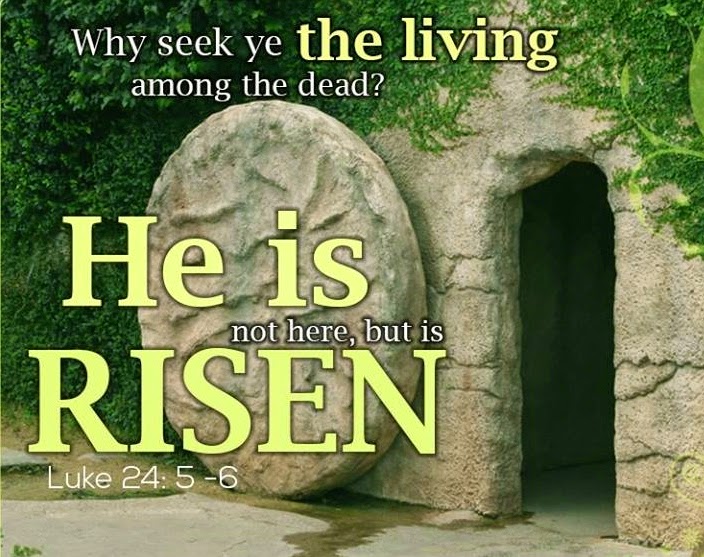
HE IS NOT HERE, HE IS RISEN!


“After the Sabbath, at dawn on the first day of the week, Mary Magdalene and the other Mary went to look at the tomb. There was a violent earthquake, for an angel of the Lord came down from heaven and, going to the tomb, rolled back the stone and sat on it. His appearance was like lightning, and his clothes were white as snow. The guards were so afraid of him that they shook and became like dead men. The angel said to the women, “Do not be afraid, for I know that you are looking for Jesus, who was crucified. He is not here; he has risen, just as he said. Come and see the place where he lay.” Matthew 28:1-6
He is not here, He is raised! These seven words declare the most important truth in the entire Bible. You may ask, “Could any truth be more important than the truth of the virgin birth of Christ or, the truth of the cross of Calvary? Or the miracles that Jesus did, healing the sick, giving sight to the blind, and restoring the dead to life?” Yes! Because, it doesn’t matters what Jesus did, or who He was, if death could have kept Him in the grave, All else would have been in vain!
The cross and the resurrection of Jesus are inseparable one demands the other. If Jesus had not died there would of course be no resurrection, hence no faith, no salvation, no new creation; but had he not conquered death, hell, and the grave His death would have been in vain. Therefore those who deny His resurrection might just as well deny that He was crucified! “Now if Christ be preached that he rose from the dead, how say some among you that there is no resurrection of the dead? But if there be no resurrection of the dead, then is Christ not risen: And if Christ be not risen, then is our preaching vain, and your faith is also vain. Yea, and we are found false witnesses of God; because we have testified of God that he raised up Christ: whom he raised not up, if so be that the dead rise not. For if the dead rise not, then is not Christ raised: And if Christ be not raised, your faith is vain; ye are yet in your sins. Then they also which are fallen asleep in Christ are perished. If in this life only we have hope in Christ, we are of all men most miserable” (I Corinthians 15:12-19).
The devil did everything in his power to keep Jesus from the cross. He knew that if Jesus reached Calvary, His death on the cross would eventually lead to the downfall of his kingdom. Satan assembled all the forces of hell, in an all-out attempt to destroy Jesus before He reached the cross, but the Bible tells us in Colossians 2:15 that Jesus, “Having disarmed the powers and authorities, he made a public spectacle of them, triumphing over them by the cross.” When Jesus prayed in the Garden of Gethsemane, He saw all the forces of hell allied together to crush Him; but an angel was sent to strengthen Him and He won the victory, putting hell to an open shame.
The devil tried to kill Jesus on the Roman whipping post and failed. He tried to kill Him under the weight of the cross and failed. Jesus came into the world to die on the cross, and all the forces of hell could not stop Him! Even after He reached the cross and died there, they thought that they could keep Him in the tomb by rolling a heavy stone across the door, sealing it with the imperial seal of Rome, and placing a Roman guard over it. But they did not reckon on the power of God and the fact that it was not possible for death to hold Him because He was God manifested in the flesh just as the gospel of St. John 1:14 tells us “And the Word was made flesh, and dwelt among us.”
It was not possible that death could hold Jesus! Death is the result of sin, “the wages of sin is death” says Romans 6:23, “Sin, when it is finished, bringeth forth death” says James 1:15, but Jesus did not sin; there was no sin in Him. Therefore death had no claim on Him. Jesus did not die as mortals die; He did not die a “natural” death. He layed His life down of Himself, that He might take it again. He said in John 10:17-18, “No man taketh it from me, but I lay it down of myself. I have power to lay it down, and I have power to take it again.” Jesus is Life, and it is impossible for death to hold life. He said in St. John 11:25: “I am the resurrection, and the life.” He took a body in order that He might die, lay His life down, and through death make eternal life possible for all who believe in Him. John 3:16: “For God so loved the world, that he gave his only begotten Son, that whosoever believeth in him should not perish, but have everlasting life.”
No man killed Jesus! It is true that men demanded His death, men arrested and condemned Him, and the hands of men nailed Him to the cross, but make no mistake, friend, man did not take His life! Jesus was God manifested in the flesh, and God cannot die or be killed.   
Pilate gave Jesus’ lifeless body to Nicodemus and Joseph of Arimathaea. They took it down form the cross and placed it in Joseph’s new tomb, but it was not possible for corruption to destroy His body, and on the third day after His burial Jesus came forth from the grave in the same body Nicodemus and Joseph had placed in the tomb! If He had not risen bodily He would not have won total victory over death.
Without His bodily resurrection He would have won only partial victory over death. But He did rise bodily, and the Word of God declares: “When this corruptible shall have put on incorruption, and this mortal shall have put on immortality, then shall be brought to pass the saying that is written, Death is swallowed up in victory. O death, where is thy sting? O grave, where is thy victory? The sting of death is sin; and the strength of sin is the law. But thanks be to god, which giveth us the victory through our Lord Jesus Christ!” (I Corinthians 15:54-57).
Thank God, He did not stop short of total victory, victory over the world, the flesh, and the devil, death, hell, and the grave. He took a body that was capable of dying and in that body He died and rose again. His bodily resurrection is the guarantee that He conquered all He came to conquer, and He now holds the keys of hell and of death. “I am the first and the last: I am he that liveth, and was dead; and, behold, I am alive for evermore, Amen; and have the keys of hell and of death.” (Rev. 1:18).  
That the dead are going to be raised to life again is taught throughout the scriptures, “Verily, verily, I say unto you,  The hour is coming, and now is, when the dead shall hear the voice of the Son of God: and they that hear shall live. For as the Father hath life in himself; so hath he given to the Son to have life in himself; And hath given him authority to execute judgment also, because he is the Son of man. Marvel not at this: for the hour is coming, in the which all that are in the graves shall hear his voice, And shall come forth; they that have done good, unto the resurrection of life; and they that have done evil, unto the resurrection of damnation” (John 5:25-29).  Two things are taught in this Scripture. The first thing is that everyone who dies is going to be raised to life again. The second thing is that some are going to be raised to life while others are going to be raised to everlasting shame and damnation.
Everyone who’s ever lived and died is going to be raise from the dead in the end of the age. They will either be raised to eternal life or to eternal damnation. What a person does with Christ will determine which of these it will be, “the rest of the dead lived not again until the thousand years were finished. This is the first resurrection. Blessed and holy is he that hath part in the first resurrection: on such the second death hath no power, but they shall be priests of God and of Christ, and shall reign with him. And I saw a great white throne, and him that sat on it, from whose face the earth and the heaven fled away; and there was found no place for them. And I saw the dead, small and great, stand before God; and the books were opened: and another book was opened, which is the book of life: and the dead were judged out of those things which were written in the books, according to their works. And the sea gave up the dead which were in it; and death and hell delivered up the dead which were in them: and they were judged every man according to their works.  And death and hell were cast into the lake of fire. This is the second death. And whosoever was not found written in the book of life was cast into the lake of fire.” (Revelation  20:5-6, 11-15).


Sunday, April 6, 2014

LA CRUCIFIXIÓN Y LA RESURRECCIÓN, ¿QUÉ DÍA?


 El respondió y les dijo: La generación mala y adúltera demanda señal; pero señal no le será dada, sino la señal del profeta Jonás. Porque como estuvo Jonás en el vientre del gran pez tres días y tres noches, así estará el Hijo del Hombre en el corazón de la tierra tres días y tres noches.”  Mateo 12:39-40

Muchas personas, por la razón de la tradición del "Viernes Santo y Domingo de Resurrección" han asumido que Jesús murió en viernes y resucitó el Domingo de Pascua. Como Jesús dijo que resucitaría al tercer día, algunos cuentan parte del viernes como un día, sábado como el segundo y parte del domingo, como el tercero. Pero cuando escudriñamos las Escrituras, hallamos que Cristo habló del período de tiempo como tres días y tres noches. ¡Del viernes por la tarde hasta el domingo por la mañana, no hay tres días y tres noches! ¿Cuál es entonces la explicación correcta?

No hubo testigos oculares de la resurrección. Aun los llamados "Padres Apostólicos" no tuvieron más fuente e información que los registros que están hoy a nuestra disposición. No fue sino hasta la muerte del último de los doce apóstoles (Juan) que la tradición de "Viernes Santo y Domingo de Resurrección" empezó a difundirse en las iglesias. ¿Cuales son los hechos registrados?

Los fariseos pedían a Jesús una señal de que era el verdadero Mesías, El les dijo que no les daría más señal que la del profeta Jonás. "Porque como Jonás estuvo en el vientre del gran pez tres días y tres noches, así estará el Hijo del Hombre en el corazón de la tierra, tres días y tres noches" (Mat. 12:39-40, 16:21; Mar. 10:34; Lc. 24:7; Jonás 1:7). Jesús declaró expresamente que la única señal que daría para probar Su dignidad de Mesías, sería Su permanencia de tres días y tres noches justos en el sepulcro.

Estos fariseos que se negaban a admitir la investidura de Cristo exigían una prueba, Jesús les ofreció solamente una prueba. Esa prueba no era el hecho de la resurrección en sí, sino el lapso de tiempo que El había de reposar en el sepulcro antes de ser resucitado. Jesús reclamo su derecho de ser el Salvador sobre Su promesa de permanecer exactamente tres días y tres noches en el sepulcro, ¡pero si el fracasaba en cumplir esta señal, debe ser rechazado como un impostor! ¡No es de extrañar que Satanás haya hecho que los incrédulos se mofen de la historia de Jonás y la Ballena! Esta única y sobrenatural prueba dada por Jesús para demostrar su mesiazgo, ha incomodado mucho a los comentaristas y a los altos críticos. Sus esfuerzos por descartar esta única prueba de la divinidad de Cristo, son ridículos en extremo. ¡Tienen que destruir esta evidencia, o sus tradiciones de "Viernes Santo y  el Domingo de Pascua" se derrumban!

Jesús estuvo en la tumba no menos ni más de 72 horas. Dios es un Dios de exactitud. El hace todo a la hora propicia. No hay nada de accidental en lo que El hace. "Pero cuando vino el cumplimiento del tiempo," no un año antes ni un año después, sino justamente a tiempo, que "Dios envió a su Hijo" (Gál.4:4). La hora de su Unigénito fue preordenada y de ella nos habló Daniel. De igual manera fue exacto el tiempo cuando Jesús fue "entregado" por los pecados del pueblo. Aquellos que trataron de matarlo antes, fallaron porque "su hora no había llegado". No solamente el día y el año de su muerte fueron preparados de antemano, ¡sino que hasta la "hora"  era parte del plan divino! "Padre...Jesús clamó..., la hora ha llegado..." (Juan 17:1).

Siendo que había una hora exacta para el nacimiento de Cristo, una hora exacta para su ungimiento, una hora exacta para el comienzo de su ministerio, una hora exacta para su muerte, no es impropio pensar que había también una hora exacta para su resurrección. Exactamente 72 horas. Un comentarista dice: "Por supuesto, sabemos que Jesús estuvo en el sepulcro solamente la mitad del tiempo que esperaba estar". ¡Algunos expositores nos embaucan hasta hacernos creer que "en la lengua griega, en que el N.T. fue escrito, la expresión 'Tres días y tres noches' indica tres períodos, ya sean del día o de la noche"! Jesús, nos dicen ellos, fue puesto en la tumba poco antes de la puesta del sol el viernes y resucitó al amanecer el domingo, dos noches y un día.

El comentarista Adam Clarke  como otros cita el Talmud judío para apoyar la idea de que tres días y tres noches supuestamente significan un día y dos noches. El Comentario Bíblico de los Adventistas del Séptimo Día implica lo mismo. Pero la Biblia no es interpretada por el Talmud judío ni por ningún comentario de hechura humana. Jesús rechazó las talmúdicas tradiciones de los judíos.

La definición de la Biblia con respecto a la duración de los "días y las noches", es muy simple. Aun estos mismos críticos admiten que en hebreo, la lengua en que el libro de Jonás fue escrito, la expresión "tres días y tres noches" quiere decir un período de 72 horas, tres días de doce horas y tres noches de doce horas. Jonás 1:17 dice, "...y estuvo Jonás en el vientre del pez tres días y tres noches". Ese, los críticos admiten, fue un período de 72 horas. Y Jesús dijo claramente, que "como estuvo Jonás tres días y tres noches" en el vientre del gran pez, ¡así El estaría el mismo lapso de tiempo en el sepulcro!

¿Sabia Jesús cuánto tiempo había en un "día"  y en una "noche”? Respondió Jesús: "¿No tiene el día doce horas? El que anda de día, no tropieza, porque ve la luz de este mundo; pero el que anda de noche, tropieza, porque no hay luz en él" (Juan 11:9-10). Ahora note usted la definición bíblica de la expresión "al tercer día". Texto tras texto nos dice, que Jesús resucito al tercer día. Vea cómo defina la Biblia el tiempo requerido para cumplir "el tercer día"

En Génesis 1:4 y 5 leemos que "separó Dios la luz de las tinieblas. Y llamó Dios a la luz Día, y a las tinieblas llamó noche. Y fue la tarde [oscuridad] y la mañana [luz] un día" [el primer día]. El versículo 8 dice: "Y llamó Dios a la expansión Cielos. Y fue la tarde [oscuridad] y la mañana [luz] el día segundo". En el versículo 13 del mismo capítulo 1 de Génesis se lee; "...y fue la tarde [ahora tres períodos de oscuridad llamados noche - tres noches] y la mañana [ahora tres períodos de luz llamados día - tres días] el día tercero". Aquí tenemos la única definición de la Biblia que explica y suma la cantidad de tiempo implicada en la expresión, "el día tercero". Jesús dijo que doce horas contenía cada período. ¡Un total de 72 horas! "Y comenzó a enseñarles que le era necesario al Hijo del Hombre padecer mucho, y ser desechado por los ancianos, por los principales sacerdotes y por los escribas, y ser muerto, y resucitar después de tres días" (Marcos 8:31).

Si Jesús hubiera muerto el viernes y resucitado después de un día, la resurrección habría ocurrido el sábado por la tarde, y si después de dos días, ésta habría acontecido la tarde del domingo, y si después e tres días, la tarde de lunes. Examine este texto cuidadosamente. Usted no puede, por ningún proceso de matemática, sumar nada menos que un total de setenta y dos horas, tres días y tres noches, en una resurrección que ocurrió tres días después de la crucifixión.

Si aceptamos todo el testimonio de la Biblia (Marcos 9:31; Mateo 27:63; Juan 2:19-21), tenemos que llegar a la conclusión de que Jesús estuvo exactamente tres días y tres noches, tres días completos de 24 horas cada uno, o sean 72 horas en el sepulcro.

Para que sean tres días y tres noches, 72 horas, los de su permanencia en el sepulcro, su resurrección tuvo que haber ocurrido exactamente a la misma hora del día en que su cuerpo fue colocado en la tumba. ¡Si podemos hallar la hora del día en que fue sepultado, habremos encontrado también la hora del día e la resurrección! Si el entierro, por ejemplo, hubiera sucedido a la salida del Sol, y era necesario que el cuerpo quedara tres días y tres noches en la tumba, la resurrección tenía que ocurrir también a la salida del Sol tres días después. Se el sepelio fue a la puesta del Sol, la resurrección ocurrió tres días más tarde al ponerse el Sol. Jesús clamó a gran voz en la cruz poco después de "la hora novena" {3:00 p.m.} (Mat. 27:46-50; Mr. 15:34-37; Lc. 23:44-46).

El día de la crucifixión fue llamado de "preparación" o un día antes del Sábado (Mt. 27:62; Mr. 15:42; Lc. 23:54; Jn. 19:31). Ese día terminó a la puesta del Sol, según la computación bíblica (Levítico 23:32).

Jesús fue enterrado antes de que el citado día terminara, antes de la puesta del Sol. Juan añade: "Allí, pues, por causa de la preparación de la pascua de los judíos, y porque aquel sepulcro estaba cerca, pusieron a Jesús" (Jn. 19:42). De acuerdo con las leyes antes de que comenzara el Sábado o algún día grande de fiesta solemne. Por eso el cuerpo de Jesús fue enterrado antes del ocaso el mismo día que murió y su muerte ocurrió poco después de las tres de la tarde.

¡El entierro del cuerpo de Cristo fue a una hora avanzada de la tarde! Fue entre los tres pasados meridianos y la puesta del Sol como estas Escrituras lo prueban. Y puesto que la resurrección tuvo que ocurrir a la misma hora del día tres días más tarde, la resurrección de Cristo ocurrió, no a la salida del Sol, sino en la tarde, ya avanzada la hora, cerca de la puesta del Sol. Las primeras investigadoras, María Magdalena y sus compañeras, vinieron al sepulcro el primer día de la semana (el domingo) muy temprano, siendo todavía oscuro, cuando el Sol comenzaba a rayar, al alba (Mr. 16:2, 9; Lc. 24:1; Jn. 20:1). Estos son los textos que según suponen indica que la resurrección tuvo lugar a la salida del Sol la mañana del domingo. 

Algunos enseñan que Marcos 16:9 enseña que la resurrección fue el domingo en la mañana. Este versículo no dice que Jesús hubiera resucitado el primer día de la semana. ¿Dice que en el primer día de la semana estaba resucitado o que resucitó a esa hora? ¡No! Dice que al llegar el primer día de la semana "ya había resucitado". Esta frase está en tiempo antipretérito. La palabra griega aquí escrita "resucitó", que es en pasado. La palabra griega no indica que Cristo resucitó en la mañana del primer día de la semana; al contrario, expresa que ya había resucitado.

Cuando la Biblia fue escrita originalmente, las comas eran desconocidas. La puntuación fue inventada por Aldus Manutions, en el siglo XV. Como los manuscritos originales no tenían puntuación alguna, los traductores añadieron las comas en donde pensaron que debían ir, basados en la lógica. En Marcos 16:9, notemos que la coma está situada después de la palabra mañana. El poner la coma aquí conecta al primer día de la semana con la hora de la resurrección. Pero si la coma se pone después de la palabra "resucitó", vemos el significado correcto de las Escrituras. Recordemos que fueron las palabras de la Biblia inspiradas, no la puntuación, que fue añadida más tarde por los hombres. El tercer día a contar del miércoles en que ocurrió el sepelio, fue Sábado; los tres días completos de permanencia en la tumba terminaron el Sábado en la tarde, poco antes de la puesta del Sol, no el domingo por la mañana.

Jesús fue crucificado el miércoles, o sea el día intermedio de la semana. El murió en la cruz un poco después de las tres de aquella tarde y fue enterrado antes de la puesta del Sol, la tarde del miércoles. Cuente tres días y las tres noches. Su cuerpo estuvo en la tumba el miércoles, jueves y viernes por la noche, tres noches. Y también estuvo allí durante la porción iluminada del día el jueves, viernes y Sábado, tres días. ¡Fue resucitado el sábado, ya tarde, un poco antes de la puesta del Sol, precisamente a la hora en que fue sepultado! Y el domingo en la mañana al amanecer ¡El ya estaba allí, ya había resucitado!  

¡Ahora llegamos a una objeción que posiblemente pueda surgir, y con todo, es precisamente el punto que prueba esta verdad! Tal vez haya observado que la Escritura dice que el día posterior a la crucifixión fue un sábado. Por leer negligentemente la Palabra de Dios, durante siglos, muchas personas ciegamente han supuesto que la crucifixión tuvo lugar un viernes.

 Ya hemos demostrado con los cuatro Evangelios que al día de la crucifixión se le llamo de "preparación" o "la víspera de la pascua". Era el día de preparación para el sábado. Pero, ¿para que sábado? El Evangelio de Juan da una respuesta "Y era la preparación de la pascua". ¿Qué es un gran día de sábado? ¡Pregunte usted a cualquier judío! Le dirá que es uno de los Días Santos anuales, o día de fiesta. ¡Los Israelitas observaban siete de éstos todos los años, y a cada uno le llamaban sábado! Los sábados anuales caen en ciertas fechas del calendario, en diferentes días de la semana y en diferentes años, así como las fiestas que se observan ahora. Estos siete Sábados anuales pueden caer lunes, jueves, domingo, etc. (Levítico 16:31; 23:15, 24, 26-32, 39).

Mateo 26:2: "Sabéis que dentro de dos días se celebra la pascua, y el Hijo del Hombre será entregado para ser crucificado". ¡Si lee usted todo este capítulo, entenderá que Cristo fue crucificado en la Pascua! Cristo es nuestra pascua, sacrificado por nosotros (I Cor. 5:7).

¡Jesús fue ofrecido en sacrificio el mismo día en que la Pascua era inmolada cada año! ¡Fue sacrificado el 14 de Abib, el primer mes del calendario hebreo! Y este día de la Pascua era el anterior o de preparación para la fiesta, o gran sábado anual, que ocurría el 15 de Abib. Este sábado puede caer en cualquier día de la semana. Frecuentemente sucede, aún hoy, y es observado por los judíos, en jueves. Los judíos observaron este gran sábado un jueves en 1982, 1989, 1992, 2001, 2005 y lo observaran un jueves en 2013.

El calendario de los hebreos muestra que en el año en que Jesús fue crucificado, el 14 de Abib, día de la Pascua, era miércoles y que el sábado anual fue jueves. Este era el sábado que se acercaba ya, cuando, José de Arimatea se apresuró a enterrar el cuerpo de Jesús casi al finalizar aquella tarde del miércoles. ¡Hubo dos sábados en esa semana!

Según Marcos 16:1, María Magdalena y sus acompañantes compraron las drogas aromáticas para ungir el cuerpo de Jesús después de que el sábado hubo pasado. Por lo tanto, no pudieron preparar dichas drogas antes del citado día. Sin embargo, después de prepararlas, "descansaron el día de reposo, conforme al mandamiento" (Lucas 23:56).

Estudie estos textos cuidadosamente. Hay solamente una posible explicación: el gran Sábado anual, el día de fiesta correspondiente a los días de los Panes sin Levadura, ese año (31 d. de J.C.) cayó jueves, y al día siguiente, es decir, el viernes, estas mujeres compraron y prepararon sus aromas y luego descansaron el Sábado semanal, conforme al mandamiento (Éxodo 20:8-11). Una comparación de estos dos textos prueba que hubo dos sábados en aquella semana, con un día intermedio. De otra manera, estos textos se contradicen.


THE CRUCIFIXION AND THE RESURRECTION, WHICH DAY?


“But he answered and said unto them, An evil and adulterous generation seeketh after a sign; and there shall no sign be given to it, but the sign of the prophet Jonas: For as Jonas was three days and three nights in the whale's belly; so shall the Son of man be three days and three nights in the heart of the earth.” Matthew 12:39-40
Many people, for the reason of the tradition of "Good Friday and Easter Sunday" have assumed that Jesus died on Friday and resurrected on Easter Sunday. Few have ever thought to question this. Because Jesus said that He would resurrect on the third day, some people count part of Friday as one day, Saturday as the second and part of Sunday, as the third day. But when we investigate the scriptures, we find that Christ spoke about the period of time as three days and three nights. From Friday evening until Sunday morning, are not three days and three nights! Which then is the correct explanation?
There were no eye witnesses of the resurrection. Even the so-called "Apostolic Fathers" did not have any more sources and information then the records that are available to us today. Tradition must be dismissed. It wasn’t until the death of the last of the twelve apostles (John) that the tradition of "Good Friday and Easter Sunday" started spreading in the churches. What are the recorded facts?
The Pharisees were asking Jesus for a sign; evidence to prove that He was the true Messiah. Jesus answered: “An evil and adulterous generation seeketh after a sign; and there shall no sign be given to it, but the sign of the prophet Jonas: For as Jonas was three days and three nights in the whale’s belly; so shall the son of man be three days and three nights in the heart of the earth” (Matt. 12:39-40, 16:21). Now consider the tremendous importance of the overwhelming significance of Jesus’ statement. He expressly declared that the only sign He would give to prove He was the Messiah was that He would be just three days and three nights in the sepulcher.
These Pharisees who refused to admit the investiture of Christ demanded proof, Jesus offered but one proof. That proof was not the fact of the resurrection itself. It was the length of time He would be in the grave, before resurrecting. Think what this means! Jesus staked His claim to being the Saviour upon remaining exactly three days and three nights in the grave, but if He failed in this sign, He must be rejected as an impostor! No wonder Satan has caused unbelievers to scoff at the story of Jonah and the Whale! This one and only supernatural proof ever given by Jesus for His Mesiahship has bothered the commentators and critics. They attempt to explain away this sole proof for Christ’s divinity. For explain this away they must, or their “Good Friday-Easter” tradition collapses!
One commentator says, “of course we know that Jesus was actually in the tomb only half as long as He thought He would be!” Some imposes on us to believe that in the Greek language, in which the N.T. was written, the expression, three days and three nights, means three periods, either of day or of night! Jesus, they say, was placed in the tomb shortly before sunset Friday, and rose at sunrise Sunday morning, two nights and one day.
The Bible definition of the duration of nights and days is simple. Even the critics admit that in the Hebrew language, in which the book of Jonah was written, the expression “three days and three nights” means a period of 72 hours, three twelve hour days and three twelve hour nights. Notice Jonah 1:17: “And Jonah was in the belly of the fish three days and three nights!” They admit it was a period of 72 hours, and Jesus distinctly said that as Jonah was three days and three nights in the great fish’s belly, so He would be the same length of time in the grave! Did Jesus know how much time was in a day and in a night? Jesus answered, “are there not twelve hours in a day...but if a man walk in the night, he stumbleth” (John 11:9-10).
The Bible definition of the expression, “the third day” text after text tells us that Jesus rose the third day. Notice how the Bible defines the time required to fulfill, “the third day” (Gen. 1:4-13).
“And he began to teach them, that the Son of man must suffer many things and be rejected of the elders and of the chief priests, and scribes and be killed and after three days rise again” (Mark 8:31). If Jesus had been killed on Friday and then after one day He had risen, the resurrection would have occurred on Saturday evening. If after two days it would have occurred Sunday evening and if after three days, it would have occurred Monday evening. Examine this text carefully. You cannot figure any less than a full 72 hours in a resurrection which occurred three days after the crucifixion! (Mark 9:31; Matt. 27:63; John 2:19-21) If we are to accept all the testimony of the Bible, we must conclude that Jesus was exactly three days and three nights, three full 24 hour days, 72 hours in the grave.
Now notice carefully this fact: in order to be three days and three nights in the tomb, Jesus had to be resurrected at exactly the same time of day that His body was buried in the tomb! If we can find the time of day of the burial, then we have found the time of day of the resurrection! If the burial, for instance, was at sunrise, then for the body to be left an even three days and three nights in the tomb, the resurrection likewise had to occur at sunrise, three days later. If the burial were at noon, the resurrection was at noon, etc.
The crucifixion day was called “the preparation” or day before the Sabbath (Mat. 27:62; Mark 15:42; Luke 23:54). This day ended at sunset, according to Lev. 23:32. Jesus cried out soon after “the ninth hour” or 3:00 p.m. (Matt. 27:46-50; Mark 15:34-37; Luke 23:44-46). Yet Jesus was buried before this same day ended, before sunset (Matt. 27:57; Luke 23:52-54). John adds, “There laid they Jesus therefore because of the Jews’ preparation day.” According to the laws observed by the Jews all dead bodies must be buried before the beginning of a Sabbath or feast day. Therefore Jesus was buried before sunset on the same day He died. He died shortly after 3:p.m. The burial of Christ’s body was in the late afternoon! It was between 3 p.m. and sunset as these scriptures prove. And since the resurrection had to occur at the same time of day, three days later, the resurrection of Christ occurred, not at sunrise, but in the late afternoon, near sunset.
The first investigators, Mary Magdalene and her companions, came to the sepulcher on the first day of the week (Sunday) very early, while it was yet dark, as the sun was beginning to rise, at dawn (Mark 16:2; Luke 24:1; John 20:1). These are the texts that most people have supposed stated that the resurrection was at sunrise Sunday morning. When the women arrived, the tomb was already open! At that time Sunday morning while it was yet dark, Jesus was not there! Notice how the angel says, “He is not here, but is risen” (Mark 16:2; Luke 24:6; Matt. 28:5-6). Jesus was already risen at sunrise Sunday morning! He rose from the grave in the late afternoon, near sunset! And since Christ was buried late Wednesday afternoon and that the resurrection took place at the same time of day three days later, we now know the resurrection of Christ occurred late Saturday afternoon.
Jesus was crucified on Wednesday, the middle day of the week. He died shortly after 3 p.m. that afternoon; was buried before sunset Wednesday evening. Now count the three days and three nights. His body was Wednesday, Thursday and Friday nights in the grave, three nights. It also was there through the daylight part of Thursday, Friday and Saturday, three days. He rose Saturday, the Sabbath, late afternoon, shortly before sunset, at the same time of day that He was buried! It is significant that in Daniel’s prophecy of the “seventy weeks” (Dan. 9:24-27), Jesus was to be cut off “in the midst of the week.” It is significant that Jesus was also “cut off” on the middle day of a literal week.
Now we come to an objection some may raise, yet the very pint which proves this truth. Perhaps you have noticed that the Bible say the day after the crucifixion was a Sabbath. Hence, for centuries, people have assumed the crucifixion was on Friday. We have seen by all four Gospels that the crucifixion day was called “the preparation.” The preparation day for the Sabbath. But for what Sabbath? It was the preparation of the Passover (John 19:14, 31).
Just what is a “high day”? Ask any Jew! He will tell you it is one of the annual holy days, or feast days. The Israelites observe seven of these every year, every one called a Sabbath! Annual Sabbaths fall on certain annual calendar dates and on different day of the week in different years, just like the Roman holidays now observed. These Sabbaths might fall on Monday, on Thursday, or on Sunday (Leviticus 16:31; 23:24, 26-32, 39). Notice Matthew 26:2, if you will follow through this chapter you will see that Jesus was crucified on the Passover! And what was the Passover? In the twelfth chapter of Exodus you will find the story of the original Passover. Following the Passover was a holy convocation or annual Sabbath (Num. 28:16-17). The Passover lamb, killed every year on the 14th of the first month called “Abib,” was a type of Christ, the Lamb of God that taketh away the sin of the world. Christ is our Passover, sacrificed for us (I Cor. 5:7).
Jesus was slain on the very same day the Passover had been slain every year. He was crucified on the 14th of Abib, the first Hebrew month of the year. And this day, the Passover, was the day before, and the preparation for, the Feast day, or annual high day Sabbath, which occurred on the 15th. of Abib. This Sabbath might occur on any day of the week. Frequently it occurs, and is observed even today, on Thursday. For instance, this “high-day” Sabbath came on Thursday in 1982, 1989, 1992, 2001, 2005 and will occur on Thursday in 2013.
The Hebrew calendar shows that in the year Jesus was crucified, the 14th of Abib, Passover day, the day Jesus was crucified, was Wednesday. And the annual Sabbath was Thursday. This was the Sabbath that drew on as Joseph of Arimathea hastened to bury the body of Jesus late that Wednesday afternoon. There were two separate Sabbaths that week!
According to Mark 16:1, Mary Magdalene and her companions did not buy their spices to anoint the body of Jesus until after the Sabbath was past. They could not prepare them until after this, yet after preparing the spices they rested the Sabbath day according to the commandment! (Luke 23:56).
Study these two texts carefully. There is only one possible explanation: After the annual high-day Sabbath, the feast day of the days of Unleavened Bread, which was Thursday, these women purchased and prepared their spices on Friday, and then they rested on the weekly Sabbath, Saturday, according to the commandment (Ex. 20:8-11). A comparison of these two texts proves there were two Sabbaths that week, with a day in between. Otherwise, these texts contradict themselves.